

Written and Reviewed by
Dr. Iswarya
BNYS (Bachelor of Naturopathy & Yogic Sciences), MD (Doctor in Medicine). Founder & Chief Naturopathy Consultant at Dr. Iswarya’s Nature Cure Centre, Chennai.
Medical registration ID – 0308/A
View credentials →Sciatica rarely arrives at a convenient time. You stand up after a long meeting and a jolt runs down your leg. Turning over in bed becomes a careful, slow manoeuvre. For many people, the pain also affects sleep, concentration and mood, which makes even simple days feel heavy.
The good news is that most sciatica improves with time and the right conservative care. This guide explains what sciatica is, why it happens, and how sciatica pain relief through naturopathy can support recovery through diet, yoga, hydrotherapy, massage and acupuncture. It also covers the warning signs that mean you should see a doctor first.
Quick summary
- Sciatica is a symptom of nerve irritation, not a disease on its own.
- Many cases settle within weeks, though some take a few months.
- Naturopathic care can ease pain and improve movement, but the strength of evidence differs from therapy to therapy.
- Numbness in the groin, leg weakness, or loss of bladder or bowel control needs emergency care.
What is Sciatica?
The sciatic nerve is the longest and thickest nerve in the body. It begins in the lower back, passes through the buttock and runs down the back of each leg. Sciatica is the pain you feel when this nerve, or one of the nerve roots that feed it, becomes irritated or compressed. It usually affects one side of the body.
Because sciatica is a symptom, the real question is always why the nerve is irritated. A disc problem, a tight muscle and a narrowed spinal canal can all cause similar pain, yet each responds best to a different approach. That is why assessment comes before treatment.
Symptoms of Sciatica
Sciatica often builds gradually rather than striking all at once. The pattern of symptoms can hint at where the nerve is being irritated.
| Symptom | What it feels like | Good to know |
| Radiating pain | Starts in the lower back or buttock and travels down one leg | Usually affects one side only |
| Deep buttock or hip ache | A throbbing pain rather than surface soreness | Often worse with pressure or sitting |
| Tingling or burning | Pins and needles, or an electric-shock feeling | May reach the foot or toes |
| Sharp pain | Sudden pain when coughing, sneezing or changing position | Caused by a brief rise in pressure on the nerve |
| Numbness or a heavy leg | The leg feels “dead” or slow to respond | Suggests longer-standing nerve pressure |
| Weakness | Trouble climbing stairs or a foot that drags | Needs prompt medical assessment |
| Pain that comes and goes | Flares with certain movements, settles with rest | Common, and does not mean it has gone for good |
What Causes Sciatica?
| Cause | What happens | Who is more likely to be affected |
| Herniated or slipped disc | The soft centre of a disc bulges out and presses on a nerve root | Adults aged 30 to 50, people who lift often |
| Spinal stenosis | The spinal canal narrows and leaves less room for nerves | Older adults |
| Piriformis syndrome | A tight buttock muscle irritates the sciatic nerve beside it | People who sit for long hours, runners, cyclists |
| Spondylolisthesis | One vertebra slips forward over the one below | Any age, often after wear or injury |
| Injury or trauma | A fall, accident or sudden awkward movement affects the spine | Anyone |
| Lifestyle factors | Prolonged sitting, weak core, excess weight and poor posture add load | Desk workers, people with sedentary routines |
| Pregnancy | Weight gain and posture changes increase pressure on the lower back | Second and third trimester |
Immediate Relief for Sciatica Pain During a Flare-Up
When a flare-up hits, most people want to know what to do right now. No single step works instantly for everyone, but these simple measures often take the edge off and are safe to try for most people. If you are looking for immediate relief for sciatica pain, start here:
- Change position often. Try not to sit or stand in one place for more than 20 to 30 minutes.
- Use cold or heat, whichever feels better. Many people like a cold pack for the first day or two and a warm pack afterwards. The evidence for either is modest, so let comfort guide you.
- Try a gentle stretch. Lying on your back and hugging one knee toward your chest can reduce pressure on the lower spine. Stop if it worsens the pain.
- Take short, easy walks. Long bed rest tends to prolong recovery, while gentle movement usually helps.
- Support your back in bed. Lie on your side with a pillow between your knees, or on your back with a pillow under your knees.
These steps are a bridge, not a solution. If the pain is severe, sudden or comes with numbness or weakness, see the safety section below.
How Naturopathy Approaches Sciatica
Naturopathy looks at the whole person rather than a single painful spot. A practitioner considers how you sit and move, how tense your muscles are, what you eat, how well you sleep and how much stress you carry. Sciatica pain relief through naturopathy begins with this broader picture, then builds a plan around your likely cause.
A typical plan may include dietary changes, yoga, hydrotherapy, massage, acupuncture and lifestyle coaching. It works best alongside a medical diagnosis, not in place of one.
Naturopathic Diet for Sciatica
Food will not repair a herniated disc, but an anti-inflammatory eating pattern supports recovery and helps you maintain a healthy weight, which reduces load on the lower spine. Diet is one of the easiest parts of sciatica pain relief through naturopathy to start at home, because it fits into everyday Indian cooking.
| Goal | Helpful foods | Why it helps |
| Calm inflammation | Turmeric (with black pepper), ginger, garlic, amla | Contain compounds with anti-inflammatory properties; research on curcumin for pain is promising but not specific to sciatica |
| Support muscles and nerves | Bananas, soaked almonds, pumpkin seeds, millets, brown rice | Good sources of magnesium, which supports muscle relaxation and nerve function |
| Maintain bone strength | Ragi, sesame seeds, curd, paneer, moringa | Provide calcium for long-term spinal health |
| Add healthy fats | Flaxseed, walnuts | Supply omega-3 fatty acids |
| Manage weight and digestion | Oats, whole wheat, bottle gourd, ridge gourd, carrots, papaya, guava | High in fibre and easy to digest |
| Stay hydrated | Water, buttermilk, coconut water, lemon water | Supports tissue health and muscle function |
Foods worth cutting back on: deep-fried snacks, refined sugar, maida-based products, heavily processed foods and excess caffeine. These tend to work against an anti-inflammatory diet.
Yoga and Movement Therapy for Sciatica
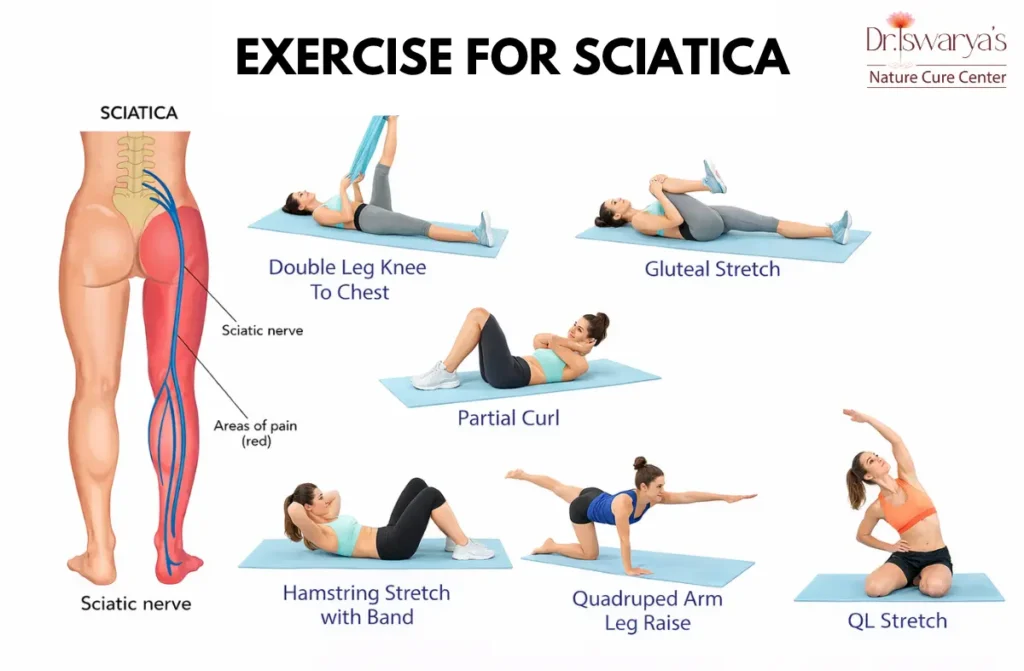
Gentle, regular movement is one of the better-supported tools for back and leg pain. It keeps the spine mobile, loosens tight muscles and builds the core strength that supports your back. Yoga is a core part of sciatica pain relief through naturopathy because it combines stretching, strengthening and breathing in one routine.
| Pose | Main benefit | Tip |
| Child’s pose (Balasana) | Gently stretches the lower back | Rest your forehead on a cushion if you feel strain |
| Cat-cow stretch (Marjaryasana-Bitilasana) | Improves spinal mobility | Move slowly with your breath |
| Single knee-to-chest stretch | Eases lower back stiffness | Hold one leg at a time |
| Lying figure-four stretch | Releases the buttock and piriformis | Keep your head and shoulders relaxed |
| Bridge pose (Setu Bandhasana) | Strengthens glutes and core | Lift only as high as is comfortable |
Aim for about 20 minutes, four or five days a week, and build up gradually. Consistency matters more than depth. If a pose sends pain down the leg, stop and ask a practitioner to adjust it. Deep hip openers such as pigeon pose can aggravate sciatica for some people, so they are best avoided during flare-ups. Our Yoga & Meditation programme offers guided sessions designed around gentle, therapeutic movement.
Naturopathic Treatments and Therapies
A structured naturopathy treatment for sciatica usually combines several therapies rather than relying on just one. The mix depends on your cause, your pain level and your general health.
| Therapy | What it involves | What to know |
| Hydrotherapy | Hip baths, spinal packs, alternating hot and cold applications | Traditionally used to ease muscle spasm and improve circulation |
| Therapeutic massage | Hands-on work around the lower back, hips and legs | Can relax tight muscles that add pressure to the nerve |
| Acupuncture and acupressure | Fine needles or pressure on specific points | Widely used for back and leg pain; research on sciatica specifically is mixed |
| Physiotherapy-based exercise | Targeted strengthening and mobility work | Builds support for the spine and improves posture |
| Lumbar traction | Gentle stretching of the lower spine | Evidence is mixed, and it is not suitable for everyone, so it needs assessment first |
| Lifestyle and stress guidance | Sleep, posture, ergonomics, breathing practices | Stress can tighten the muscles around the spine |
Explore our naturopathy treatments, physiotherapy and acupuncture services to see how these are delivered in a supervised plan.
Best Medicine for Sciatica Pain: What Naturopathy Offers
People often ask about the best medicine for sciatica pain, and the honest answer is that no single herb or pill works for everyone. Naturopathy draws on a group of supportive remedies, and they work best alongside movement, posture correction and proper diagnosis:
| Remedy | How it is used | Caution |
| Turmeric with black pepper | Added to food or taken as warm turmeric milk | May interact with blood thinners; check with your doctor |
| Ginger tea | One to two cups a day | Can upset the stomach if taken in excess |
| Castor oil pack | Applied over the lower back with gentle warmth | Avoid during pregnancy without medical advice |
| Ashwagandha | Taken under practitioner guidance | Can interact with thyroid, sedative and other medicines |
If you are already taking painkillers, blood thinners or other regular medicines, speak with your doctor before starting any herbal remedy.
How to Cure Sciatica Permanently: What Long-Term Recovery Really Means
Many people search for how to cure sciatica permanently. For a large number of them, sciatica does settle completely, especially when it comes from a disc flare-up, muscle tightness or posture. The main challenge is preventing it from returning. Naturopathy contributes most on that side, by helping you build habits that protect your spine. In practice, that means:
- Correcting posture and movement patterns that repeatedly load the lower back, such as how you sit, lift and stand.
- Strengthening the core and back muscles through yoga and physiotherapy.
- Keeping a healthy weight and following an anti-inflammatory diet even after the pain eases.
- Managing stress, since ongoing muscle tension can trigger a relapse.
- Getting structural problems reviewed, such as severe spinal stenosis, which may need long-term management or a spine specialist’s opinion.
A personalised assessment is the only reliable way to know which situation applies to you.
A Sample Week: What a Recovery Routine May Look Like
Here is how a typical week of sciatica pain relief through naturopathy might be organised. Your own plan will be adjusted to your diagnosis and comfort.
| Time of day | Activity |
| Morning | 10 minutes of gentle stretches, then a short walk |
| Breakfast | Anti-inflammatory choices such as ragi porridge, or idli with vegetable sambar |
| Midday | Change position every 30 minutes if you sit at work; light stretching breaks |
| Afternoon | Hydration with buttermilk or coconut water |
| Evening | Yoga session of about 20 minutes, four to five days a week |
| Night | Warm compress if it helps, then sleep with a pillow between your knees |
| Weekly | Supervised therapy sessions at the centre, such as massage, hydrotherapy or acupuncture |
When to See a Doctor Immediately
Most sciatica improves with conservative care, but some symptoms need urgent attention.
| Warning sign | What it may mean | What to do |
| Numbness in the groin, genitals or inner thighs | Possible cauda equina syndrome | Go to an emergency department immediately |
| Loss of bladder or bowel control | Possible cauda equina syndrome | Emergency care |
| Sudden, severe pain with leg weakness | Significant nerve compression | See a doctor urgently |
| Weakness that keeps getting worse | Progressive nerve damage | Seek prompt medical evaluation |
| Pain after a fall or accident | Possible fracture or spinal injury | Get medical imaging and assessment |
| Fever with back pain | Possible infection | Seek urgent care |
Naturopathy is not a substitute for emergency care in these situations.
What to Expect at Dr. Iswaryas Nature Cure Center
Starting treatment for sciatica can feel uncertain, especially if the pain has already disrupted your sleep and work. Here is how a typical visit and treatment plan works, so you know what to expect before you book.
Step 1: Consultation and assessment
Your first visit begins with a conversation. Dr. Iswarya asks when the pain started, what makes it better or worse, how you sit and sleep, what you eat, and what medicines or scans you have already had. Please bring any MRI reports, X-rays or prescriptions. A physical examination follows, checking your posture, spinal movement, muscle tightness and leg strength. If anything suggests a problem that needs medical attention first, you will be referred to a doctor or spine specialist before therapy begins.
Step 2: A plan built around your cause
Sciatica from a disc problem needs a different approach from sciatica caused by a tight piriformis muscle or long hours of sitting. Your plan is built around your likely cause and your comfort level. This personalised approach is what makes sciatica pain relief through naturopathy more than a fixed list of therapies.
| Stage | What it usually involves | Typical timing |
| Initial consultation | History, examination, review of reports, goal setting | [30 to 45 minutes, confirm] |
| Early phase | Pain and spasm relief with hydrotherapy, massage and gentle movement, plus a simple diet plan | [Weeks 1 to 2, confirm] |
| Building phase | Yoga, targeted strengthening, posture correction and acupuncture where suitable | [Weeks 2 to 6, confirm] |
| Maintenance phase | Home routine, diet, ergonomic advice and periodic review | [Ongoing, confirm] |
Your timeline depends on your diagnosis, how long you have had symptoms and how consistently you follow the home routine.
Step 3: Therapies and home guidance
Sessions at the centre may include hydrotherapy, therapeutic massage, acupuncture, guided yoga and physiotherapy-based exercise. You will also receive simple instructions for home: which stretches to do, foods to favour or limit, how to set up your workstation, and how to sleep comfortably. [Add any specifics, such as diet charts provided, WhatsApp follow-up, or take-home exercise sheets.]
Step 4: Review and adjustment
Progress is reviewed at regular visits. Pain levels, walking tolerance, sleep and movement are checked, and the plan is adjusted. Some people notice easier movement within the first couple of weeks, while others need longer. Nobody should expect a guaranteed result or a fixed timeline.
What to bring and wear
- Previous scans, reports and current medication list
- Loose, comfortable clothing
- A list of questions or goals, such as “sit through a workday” or “sleep through the night”
Who may need a doctor first
Naturopathy is not the right first step if you have numbness in the groin, loss of bladder or bowel control, rapidly worsening leg weakness, or pain after a serious injury. In those cases, please seek emergency care. Our team will also refer you onward if your assessment shows that you need imaging, medication or a spine specialist’s input.
Conclusion
Sciatica can be frightening and exhausting, but it rarely has to mean years of pain. Understanding what triggered it, staying gently active, eating in a way that calms inflammation and using therapies such as yoga, massage and acupuncture can all help you recover and lower the chance of it coming back. Sciatica pain relief through naturopathy works best when it is personalised, medically aware and consistent. Dr. Iswarya designs each plan around your cause, your daily routine and your health history.
If sciatica is affecting your work or sleep, book a consultation at Dr. Iswaryas Nature Cure Center to discuss a plan that fits you.
Related reading: Exploring a Naturopathic Approach to IBS.