

Written and Reviewed by
Dr. Iswarya
BNYS (Bachelor of Naturopathy & Yogic Sciences), MD (Doctor in Medicine). Founder & Chief Naturopathy Consultant at Dr. Iswarya’s Nature Cure Centre, Chennai.
Medical registration ID – 0308/A
View credentials →Kidney stones have a way of striking without warning — a dull ache in the back or side that can build into sharp, wave-like pain within hours. If you’ve been through it once, you already know why so many people search for home remedies for kidney stones to manage the discomfort and avoid a repeat episode. If you’re reading this to prevent a first occurrence, you’re asking exactly the right question at the right time.
This guide covers what these natural approaches can realistically do, their limitations, and which options have the most support behind them — so you can make an informed decision about your kidney health.
What are Kidney Stones?
Kidney stones are hard deposits made of minerals and salts that form inside the kidneys. They develop when urine becomes too concentrated, allowing minerals to crystallize and clump together over time. There are four main types:
- Calcium oxalate stones – the most common variety, closely tied to diet and hydration habits
- Uric acid stones – often linked to dehydration, high-protein diets, or gout
- Struvite stones – usually triggered by urinary tract infections
- Cystine stones – caused by a rare inherited condition
Typical symptoms include sharp pain in the back or side, discomfort while urinating, blood in the urine, nausea, and a frequent urge to urinate. If any of this sounds familiar, getting a proper diagnosis — usually through imaging — is the right first step, since the best approach depends heavily on the stone’s type and size.
Understanding Kidney Stone Risk Factors
Before exploring natural remedies for kidney stones, it helps to understand what raises your risk in the first place. Common contributing factors include:
- Low fluid intake – Concentrated urine gives minerals more opportunity to crystallize.
- Family or personal history – A previous stone, or a close relative who’s had one, raises your odds.
- Diet – High sodium, excess animal protein, and oxalate-heavy foods all play a role.
- Certain medical conditions – Obesity, gout, hyperparathyroidism, and some digestive disorders (like Crohn’s disease) increase risk.
- Climate and lifestyle – Hot climates and jobs involving heavy sweating raise the chance of dehydration-related stones.
Knowing your personal risk factors makes it easier to choose which natural approaches are actually worth prioritizing for you.
When to See a Doctor First
Before trying any remedy, it helps to know when home care simply isn’t enough. Seek medical attention if you notice:
- Severe pain that doesn’t ease with over-the-counter relief
- Fever or chills, which can signal an infection
- Persistent nausea or vomiting
- Visible blood in your urine
- Difficulty or inability to urinate
Stones larger than roughly 5mm often won’t pass on their own and may need a medical procedure. Home remedies for kidney stones work best for prevention and for helping smaller stones pass — they’re not a substitute for care when symptoms turn serious. At a facility like Dr. Iswarya’s Nature Cure Center, natural approaches are typically used to complement — not replace — proper diagnosis and medical oversight.
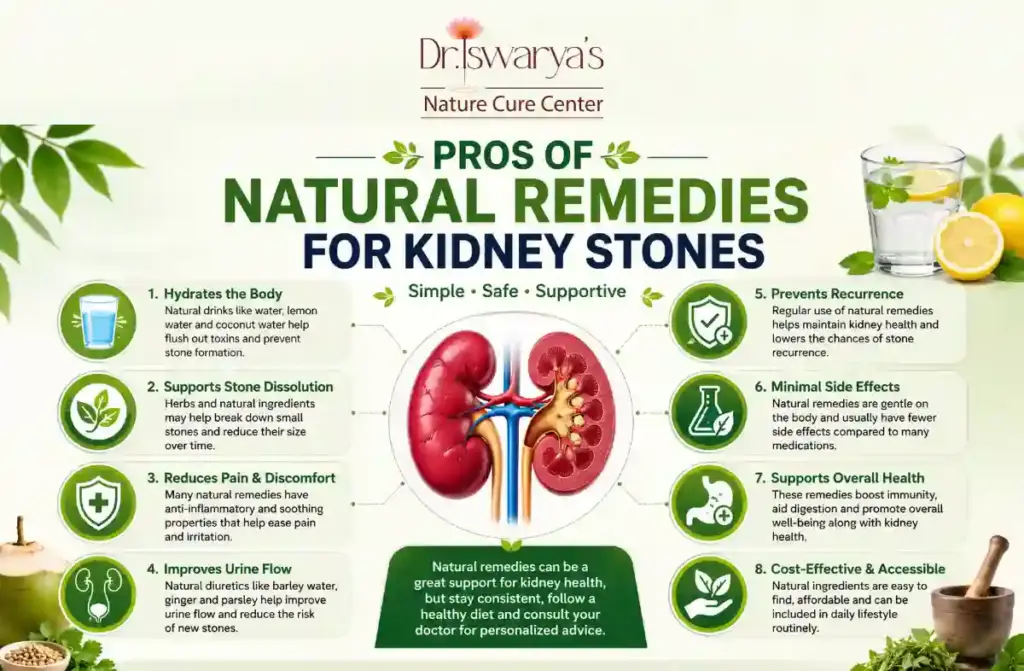
Pros of Natural Remedies for Kidney Stones
There’s a reason natural approaches remain popular alongside conventional treatment:
- Low risk – Most remedies use everyday foods and drinks, so the chance of harmful side effects is generally low when used sensibly.
- Hydration-focused – Many remedies center on fluid intake, one of the most consistently supported ways to prevent stones from forming.
- Prevention over cure – Dietary and lifestyle changes address root causes rather than just symptoms, which can lower the odds of recurrence.
- Accessible and affordable – No prescription or specialist visit required to start drinking more water or adjusting your diet.
- Complementary, not competing – Many remedies can be used safely alongside doctor-recommended treatment, with your physician’s approval.
Cons of Natural Remedies for Kidney Stones
It’s just as important to go in with realistic expectations:
- Limited clinical evidence – Many popular claims, like the idea that lemon juice can fully dissolve stones, rest on tradition or small studies rather than large clinical trials.
- Not a fix for large stones – Stones over 5mm, or those causing a blockage, typically need medical intervention regardless of home care.
- Risk of delay – Leaning entirely on home remedies while symptoms worsen can delay necessary treatment and raise the risk of complications.
- Not one-size-fits-all – A remedy that helps prevent calcium oxalate stones may do little — or even work against you — if you have uric acid or cystine stones.
- Some remedies carry their own risks – High-dose vitamin C supplements, for instance, have been linked to higher oxalate levels in some people, which could raise rather than lower stone risk.
Effective Home Remedies for Kidney Stones
Here are some of the most commonly recommended herbal remedies for kidney stones and natural approaches, along with the reasoning behind each one.
Lemon Juice and Olive Oil
Lemons are rich in citrate, a compound that may help prevent calcium stones from forming and can assist in breaking down small existing stones. Some people combine lemon juice with olive oil, though the olive oil’s benefit is more traditional than evidence-based. A glass of water with fresh lemon juice each day is one of the simplest home remedies to dissolve kidney stones that people try first.
Apple Cider Vinegar
Apple cider vinegar contains acetic acid, which some believe may help ease stone-related discomfort. The evidence is largely anecdotal, but diluted in water, it’s generally safe for most people to try in moderation as part of a broader kidney stone pain relief at home routine.
Basil
Basil has long been used in traditional Ayurvedic medicine to support kidney health. It contains acetic acid and other compounds thought to help reduce stone formation and ease discomfort. Basil tea or fresh basil juice are common ways to work this herbal remedy into your diet.
Pomegranate Juice
Pomegranate offers both antioxidant and astringent properties and has traditionally been used to support urinary tract health. A few small studies suggest it may help reduce certain stone-forming risk factors, though larger studies are still needed.
Celery Juice
Celery is thought to act as a mild diuretic, potentially helping flush out small stone fragments while also contributing to daily hydration.
Wheatgrass Juice
Wheatgrass is often promoted for its diuretic effects, which may support urine flow and help small stones pass naturally. As with several remedies here, evidence is limited but the risk of trying it is low.
Kidney Bean Broth
A traditional folk remedy, kidney bean broth is made by boiling beans and straining the liquid. It’s believed to support urinary tract health, though scientific backing is minimal — it does, however, double as a good source of hydration.
Quick Reference: Home Remedies at a Glance
| Remedy | Best For | How Often |
| Lemon water | Calcium oxalate stone prevention | Daily |
| Apple cider vinegar (diluted) | General pain support | 1–2 times daily |
| Basil tea | Overall kidney support | Daily |
| Pomegranate juice | Antioxidant support | 3–4 times weekly |
| Celery juice | Mild diuretic effect | Daily |
| Coconut water | Hydration and electrolytes | Daily |
| Kidney bean broth | Traditional urinary support | 2–3 times weekly |
Hydration-Based Remedies
Hydration deserves its own spotlight, since it’s the single most evidence-backed factor in preventing kidney stones.
- Water intake – Aim to drink enough throughout the day that your urine stays light yellow; this dilutes the minerals that form stones.
- Lemon water or citrate-rich drinks – Combines hydration with citrate for a two-in-one preventive benefit.
- Coconut water – Naturally hydrating and rich in electrolytes, making it a popular alternative to plain water.
Dietary Adjustments to Prevent Recurrence
Once you’ve had one kidney stone, your risk of another goes up — which makes diet a genuine long-term prevention tool, not just a short-term fix.
Foods to reduce:
- High-oxalate foods (spinach, beets, nuts, chocolate) if you’re prone to calcium oxalate stones
- Excess sodium, which raises calcium levels in urine
- Large amounts of animal protein, linked to both calcium and uric acid stones
Foods to increase:
- Citrate-rich fruits (lemons, oranges, limes)
- Calcium-rich foods in moderation — adequate dietary calcium can actually help reduce stone risk by binding oxalate in the gut
- Water-rich fruits and vegetables
Lifestyle Tips
Diet aside, a few daily habits also play a role in prevention:
- Stay active – Regular movement supports overall metabolic health, which is tied to lower stone risk.
- Maintain a healthy weight – Obesity is associated with a higher likelihood of stone formation.
- Cut back on processed foods – These tend to be high in sodium and low in the nutrients that support kidney health.
Kidney Stone Prevention Checklist
A quick, practical checklist to revisit regularly:
- Drink enough water to keep urine pale yellow
- Include a citrate-rich food or drink daily (like lemon water)
- Limit sodium and processed foods
- Moderate animal protein intake
- Get regular physical activity
- Track any personal or family history of stones
- Schedule periodic checkups if you’ve had a stone before
Myths vs. Facts About Natural Kidney Stone Remedies
Myth: Lemon juice can dissolve any kidney stone. Fact: Citrate may help with very small stones and prevention, but it won’t dissolve larger, established stones.
Myth: If a home remedy is natural, it’s automatically safe. Fact: “Natural” doesn’t mean risk-free — some herbal remedies for kidney stones can interact with medications or worsen certain stone types.
Myth: Drinking more water only matters during an active stone episode. Fact: Consistent daily hydration is one of the most effective long-term prevention strategies, not just a short-term fix.
Myth: All natural remedies work the same way for every stone type. Fact: Effectiveness varies by stone composition — what helps with calcium oxalate stones may not help with uric acid or cystine stones.
What Home Remedies Can’t Do
It’s worth being upfront about the limits here. Natural remedies aren’t a guaranteed way to dissolve or eliminate stones, especially larger ones. If a stone is too big to pass, or is causing a blockage, infection, or severe pain, procedures like lithotripsy (sound wave therapy), ureteroscopy, or surgery may be necessary. Home remedies for kidney stones work best as prevention and gentle support for smaller stones — not as a replacement for professional care when it’s genuinely needed.
Conclusion
Home remedies for kidney stones can genuinely help with prevention and easing discomfort in smaller cases — hydration, citrate-rich foods, and thoughtful dietary choices are backed by real, if sometimes limited, evidence. But they do have limits, particularly with larger stones or more severe symptoms. The safest path forward is treating natural remedies for kidney stones as part of a broader plan that includes regular checkups and an honest conversation with your doctor about your specific stone type and risk factors.
If you’ve had a kidney stone before, or suspect you might have one now, it’s worth reaching out to a specialist or exploring personalized wellness and preventive care options — early diagnosis makes treatment simpler and helps head off complications down the line.